
How to Read a Peptide Certificate of Analysis | AdAstra Labs
A certificate of analysis is the only document that tells you what is actually inside a vial. Everything else — the product name, the label, the supplier's description — is a claim. The COA is a measurement.
Most buyers glance at the purity figure and close the file. That number is the least informative part of the document. Here is what is worth reading instead.
1. Purity
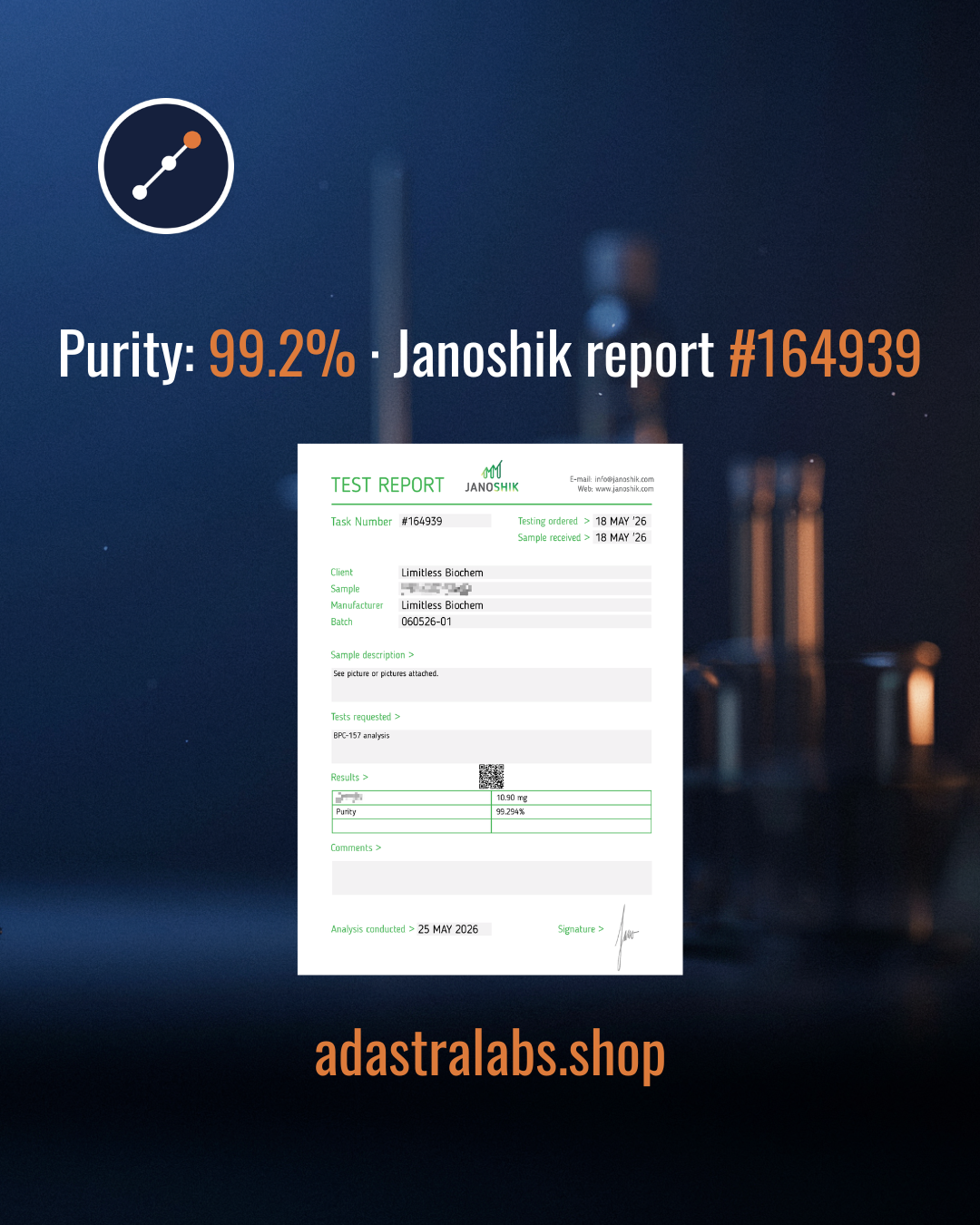
Purity is expressed as a percentage and describes how much of the sample is the target compound, as separated by chromatography. A figure of 99.3% means that under the analytical method used, 99.3% of what was measured corresponds to a single peak identified as the target.
Two things this number does not mean. It is not a statement about the entire batch — it describes the sample that was submitted. And it says nothing about identity on its own: a sample can be 99% one substance without that substance being what the label says.
As a rough guide, anything below 98% on a synthetic peptide deserves a question. Not necessarily a rejection, but a question.
2. Identity — and why the method matters
This is the part most people skip, and it is the part that separates a meaningful report from a decorative one.
HPLC (high-performance liquid chromatography) separates the components of a sample and measures their relative abundance. It answers the question: how much of this sample is one single thing?
Mass spectrometry measures molecular weight. It answers a different question: is that single thing the molecule it is supposed to be?
A report with HPLC alone tells you the sample is pure. It does not tell you what it is pure of. A report with both tells you the sample is a specific molecule at a specific purity. The difference matters, and a supplier publishing only a chromatogram is showing you half the document.
Look for both methods named explicitly. BPC-157 10mg
3. Measured content
A vial labelled 10 mg contains whatever was put into it, which is not necessarily 10 mg. Filling is a physical process with tolerances.
A good report states the measured mass, not the declared one. If a certificate simply repeats the label figure, no one weighed anything — the number was copied from the specification.
Measured content slightly above the declared amount is normal and generally in the buyer's favour. Content significantly below it is worth raising with the supplier.
This figure also changes what price comparison means. A 10 mg vial that measures 9.1 mg and a 10 mg vial that measures 10.9 mg are not the same purchase at the same price.
4. Batch number
The single most important field on the document, and the easiest one to verify.
The batch number on the report must match the batch number on the vial in your hand. If it does not, the report describes different material — produced at a different time, possibly by a different synthesis run, and analysed separately.
A supplier who publishes one certificate and applies it to every vial of that product is not providing verification. They are providing a sample of what verification would look like.
Check this first. It takes two seconds and it invalidates everything else if it fails.
5. The laboratory
A certificate should name the laboratory that performed the analysis, and that laboratory should be independent of the supplier.
"Tested in-house" is not third-party testing. A supplier analysing its own product has a direct interest in the figure it publishes. That does not make the result wrong, but it removes the reason to trust it.
The laboratory should also be contactable. Several analytical labs serving this sector publish their reports in a searchable database, which means a report number can be checked at source rather than taken on faith from a PDF. A PDF can be edited. A database entry is harder to fabricate.
If a certificate names no laboratory at all, treat it as a marketing asset rather than a document.
6. Date of analysis
The least discussed field and a useful one.
Analysis dated close to the production of the batch describes material in its tested state. Analysis dated a long time before the product reached you tells you less, because everything between the test and the delivery — storage, transport, temperature — falls outside the scope of the report.
The date also tells you something about the supplier's process. Batches analysed as they arrive suggest testing is routine. A certificate dated years earlier suggests it was done once.
What a certificate cannot tell you
A COA describes one sample, at one moment, under one method. It does not cover how the material was handled after testing, whether the cold chain held, or what happened during transport.
That is a limit of the document, not a flaw in it. It is worth understanding so that a certificate is read as what it is: strong evidence about a specific batch at a specific point in time, and nothing beyond that.
The short version
Before you buy anything in this category, open the certificate and check six fields:
- Purity — measured percentage, not a range
- Method — HPLC and mass spectrometry, both named
- Content — measured mass, not the label figure
- Batch number — matching the vial
- Laboratory — named, independent, verifiable
- Date — recent, tied to the batch
If a supplier cannot show you a document with all six, that is the answer to the question you were asking.
Every batch in our catalogue has its own report published on the product page, with the analysis linked directly at source.
Reconstituting a lyophilized sample? See Bacteriostatic water vs sterile water.
For research use only. Not for human or veterinary use.