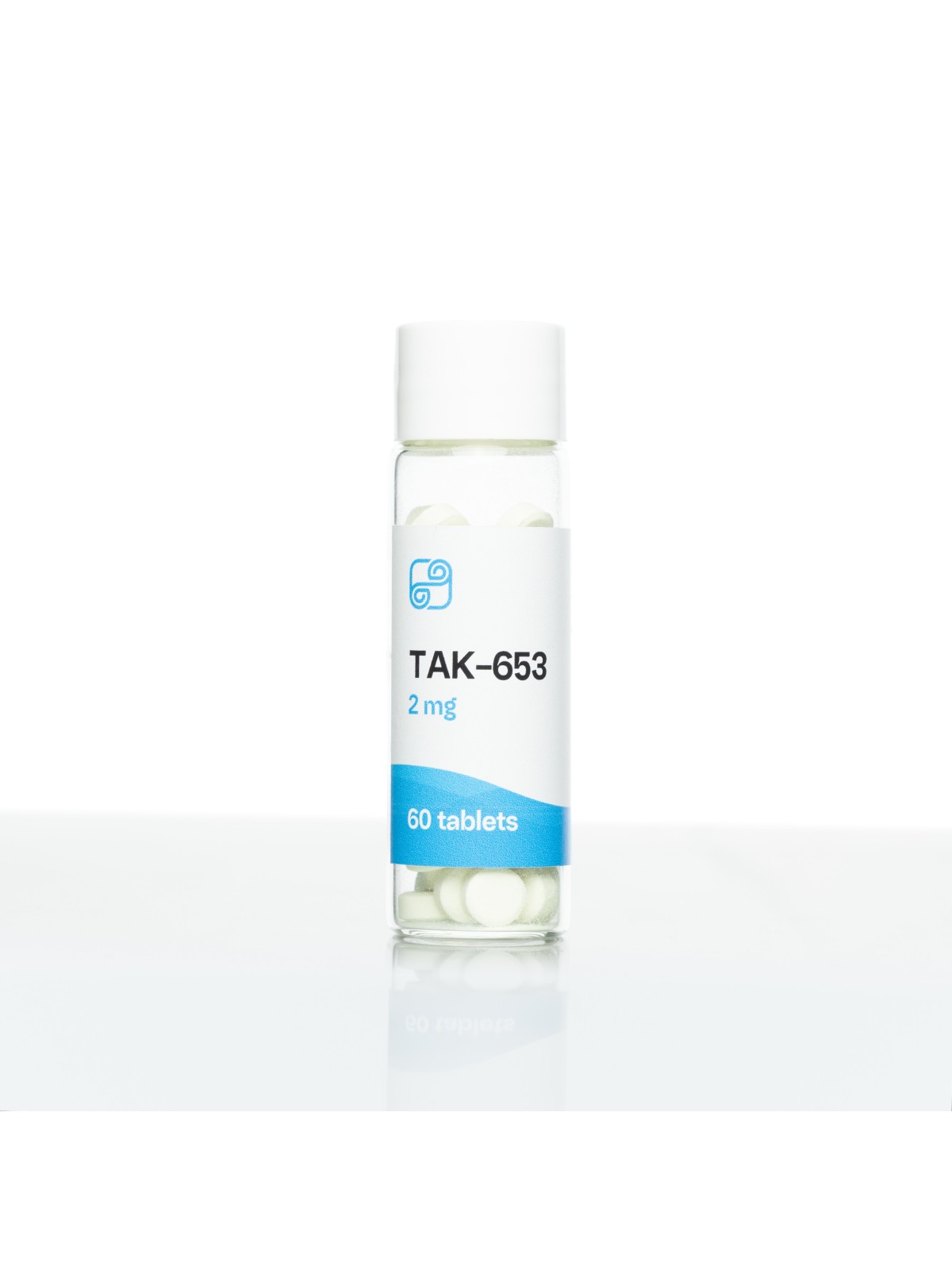

TAK-653 (Osavampator) 2mg
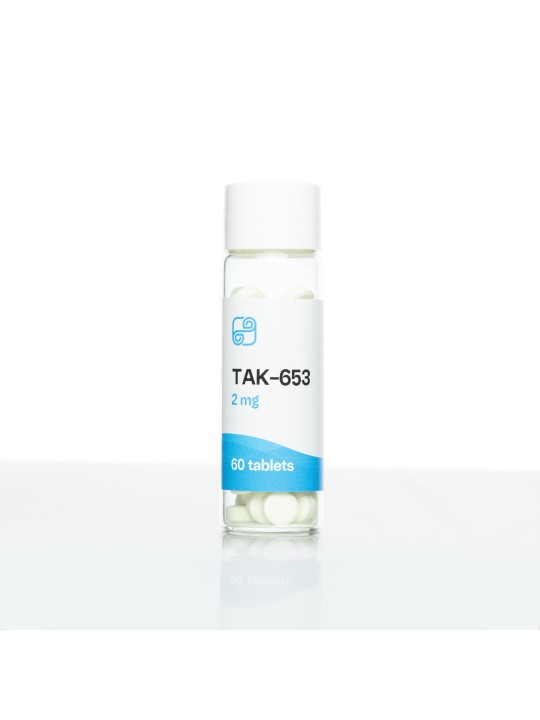
TAK-653 (Osavampator, NBI-1065846) 2mg — 60 research tablets. TAK-653 is the most clinically advanced AMPA-receptor positive allosteric modulator (PAM) in development: a non-dissociative, non-psychotomimetic glutamate-system molecule that — in published Phase II data — produced ketamine-comparable improvements in treatment-resistant depression without the hallucinogenic, dissociative or addictive liabilities of NMDA antagonists. In healthy human PET, a single oral dose increases cortical AMPA-receptor signaling within hours, providing a clean pharmacological probe of the glutamatergic side of rapid-acting antidepressant pharmacology.
Research Use Only: Laboratory research use only. Not for human or veterinary use.
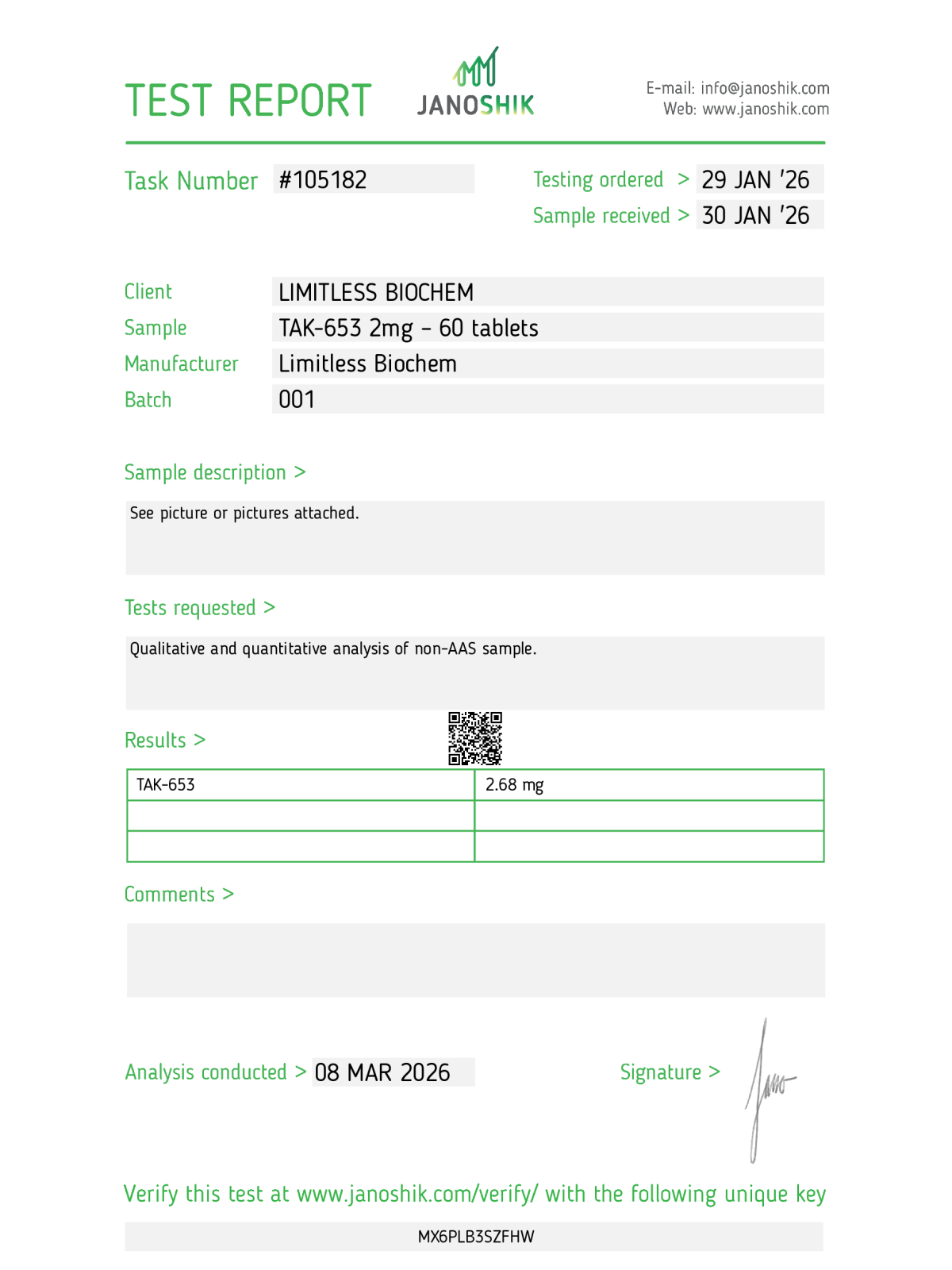
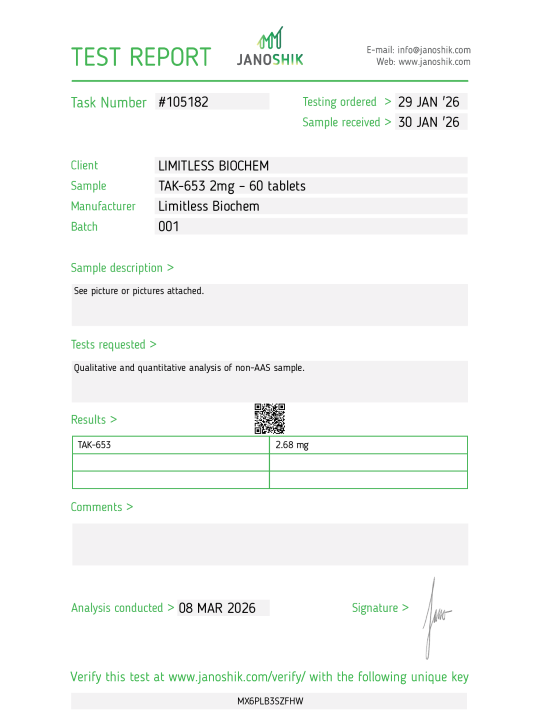
Third-Party Tested
This product is third-party tested — view the certificate of analysis and laboratory verification.
Research Overview
TAK-653 is a selective, non-desensitizing positive allosteric modulator of the AMPA subtype of ionotropic glutamate receptors, the principal mediator of fast excitatory neurotransmission in the mammalian brain [1]. Unlike older AMPA-PAMs, it has been engineered to lack the convulsant liability of high-efficacy ampakines while retaining robust enhancement of synaptic AMPA signaling in physiologically relevant ranges. In a placebo-controlled Phase II trial in treatment-resistant depression, eight weeks of daily oral 2–6mg produced marked, statistically significant separation from placebo on MADRS — comparable in magnitude to the rapid-acting NMDA antagonists, but without the dissociative or transient-psychotomimetic effects that complicate ketamine-class molecules [2]. Human [¹¹C]K-2 PET imaging confirms direct, dose-related occupancy at brain AMPA receptors after a single oral dose [3]. The molecule has now advanced under Neurocrine Biosciences as NBI-1065846 in pivotal trials, and represents the first credible non-NMDA, non-dissociative, rapid-acting antidepressant chemotype.
Primary Research Areas
- AMPA-receptor positive allosteric modulation — the most clinically advanced selective AMPA-PAM available as a research tool; the reference compound for non-desensitizing AMPA signaling research [1].
- Rapid-acting antidepressant mechanisms — Phase II evidence in treatment-resistant depression with magnitude comparable to ketamine-class molecules but without dissociation [2].
- Glutamatergic synaptic plasticity — studied for LTP enhancement, BDNF release and synaptogenesis — the proposed mechanism of rapid antidepressant action [1].
- Cognitive and procognitive research — evaluated in working-memory and executive-function paradigms in healthy human and rodent cohorts [1].
- Translational PET pharmacology — the only AMPA-PAM with confirmed direct human brain receptor occupancy via [¹¹C]K-2 PET [3].
References
- Hara H, Suzuki H, Itoh A, et al. TAK-653, an AMPA receptor potentiator with minimal agonistic activity, produces antidepressant-like effects with a wide safety margin. Neuropsychopharmacol Rep. 2021;41(3):343–352.
- O’Gorman C, Khatib R, Mathews M, et al. NBI-1065846/TAK-653 in adults with treatment-resistant depression: results of a Phase II randomized, double-blind, placebo-controlled study. Presented at: American Society of Clinical Psychopharmacology, 2024.
- Miyazaki T, Nakajima W, Hatano M, et al. Visualization of AMPA receptors in living human brain with positron emission tomography. Nat Med. 2020;26(2):281–288.
Lab data
| Purity: | ≥ 99 % (HPLC) — third-party tested, CoA on file |
| Form: | Research tablets |
| Content: | 2mg TAK-653 (osavampator) per tablet |
| Total: | 60 tablets per bottle (120mg total) |
| Packaging: | Sealed bottle with tamper-evident closure |
| Storage: | Room temperature, dry, protected from light |
| Molecular formula: | C₁₇H₁₆F₄N₂O₃S |
| Molecular weight: | ≈ 404.38 g·mol⁻¹ |
| IUPAC name: | 1-(1H-pyrazol-1-yl)-3-({6-[2-(trifluoromethyl)pyridin-4-yl]-2H-1,3-benzodioxol-2-yl}methylsulfonyl)propan-2-ol (representative) |
| CAS number: | 1432044-21-9 |
| Synonyms: | Osavampator; NBI-1065845; AMPA-receptor PAM |
Warning
This product is not intended for human or veterinary use. It is for collection or research purposes only. It cannot be used as food, dietary supplement or medicine! The information provided in the text on this page is for educational purposes only and does not constitute medical or other advice.